After 10 years building a WordPress plugin business to $1.6m a year, Katie expanded into Shopify and discovered that being new let her see things Shopify-native developers can't, because they're too close to notice them. This talk walks through the practices WooCommerce takes for granted that barely exist in the Shopify world, and why an outsider's view also surfaces the AI threat Shopify devs should be acting on now, before platform growth stops masking it.
The slides, right here.

Katie Keith is the founder and CEO of Barn2, where she's spent 10 years building a WordPress and WooCommerce plugin business to $1.6m in annual revenue, with 19 plugins and a team of 14. In 2025 she expanded into Shopify, launching Barn2's first app, Bundles & Bulk Discounts, and documenting the journey publicly through her #ShopifyDiary series on X. She co-hosts the WP Product Talk and Do the Woo podcasts.
Read the full talk
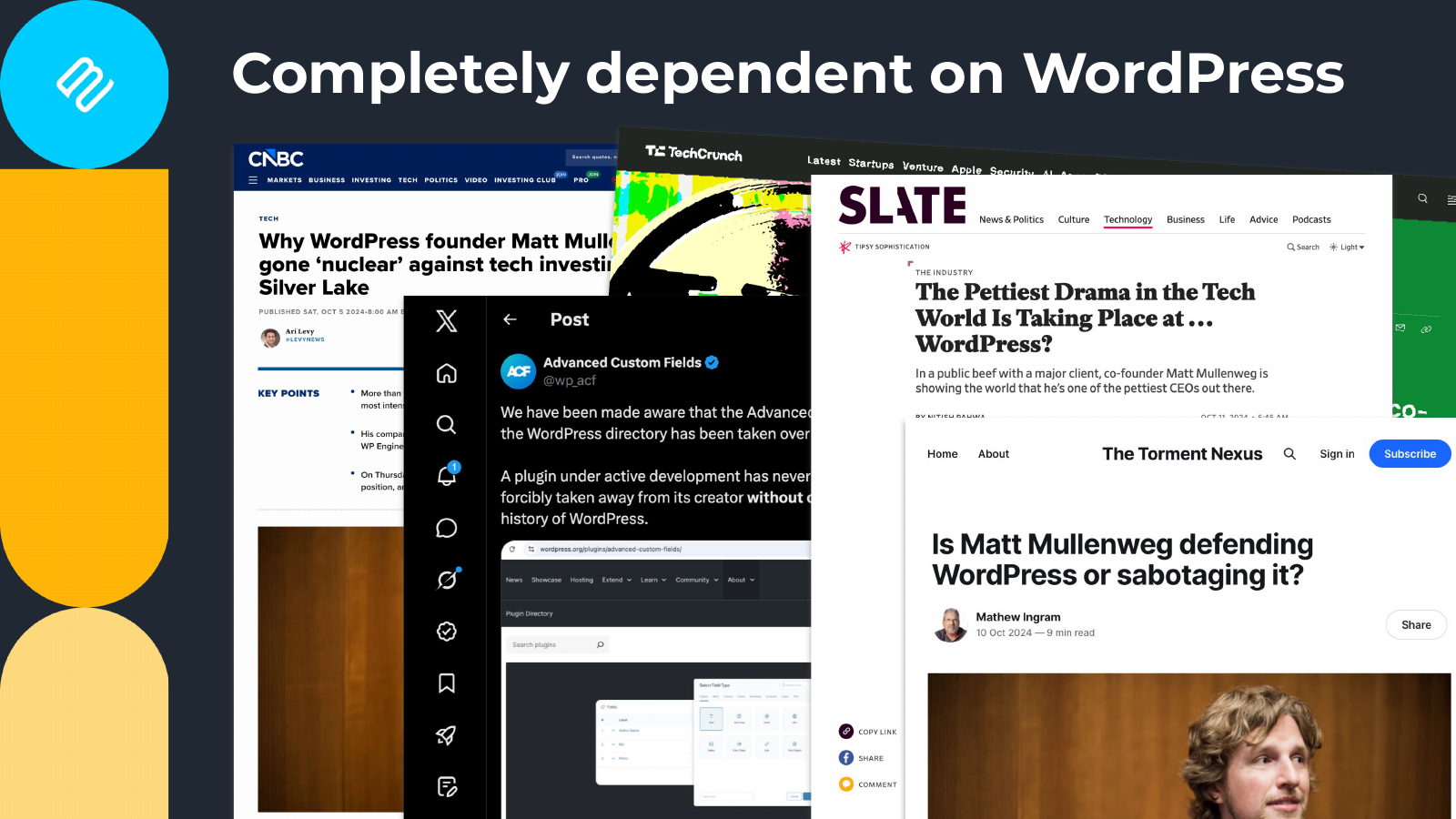
Katie: So I spent 10 years building a WordPress and WooCommerce plug-in business and we previously did that, we had an agency and everything went great. We grew rapidly, revenue was getting towards two million a year and then September 2024 happened. Matt Mullenweg, the founder of WordPress, went to war with a major hosting company.
He got himself massively sued and it felt like the community was tearing itself apart. Now at Barn 2 I had always felt diversified because we had 19 different WordPress plugins but for the first time this scared me and I realised we're not diversified at all because we are entirely dependent on WordPress. And I felt that the actions of what was happening at the time was undermining the reputation of WordPress and that that could affect our business.
I even had a call with Matt Mullenwagon, highlighted my concerns, he didn't get it at all. So I decided that the best way to safeguard the future of my business was to be on multiple platforms. Shopify made sense, 15 of our 19 plugins of WooCommerce, so while we didn't have any experience with Shopify, we do know a lot about e-commerce.
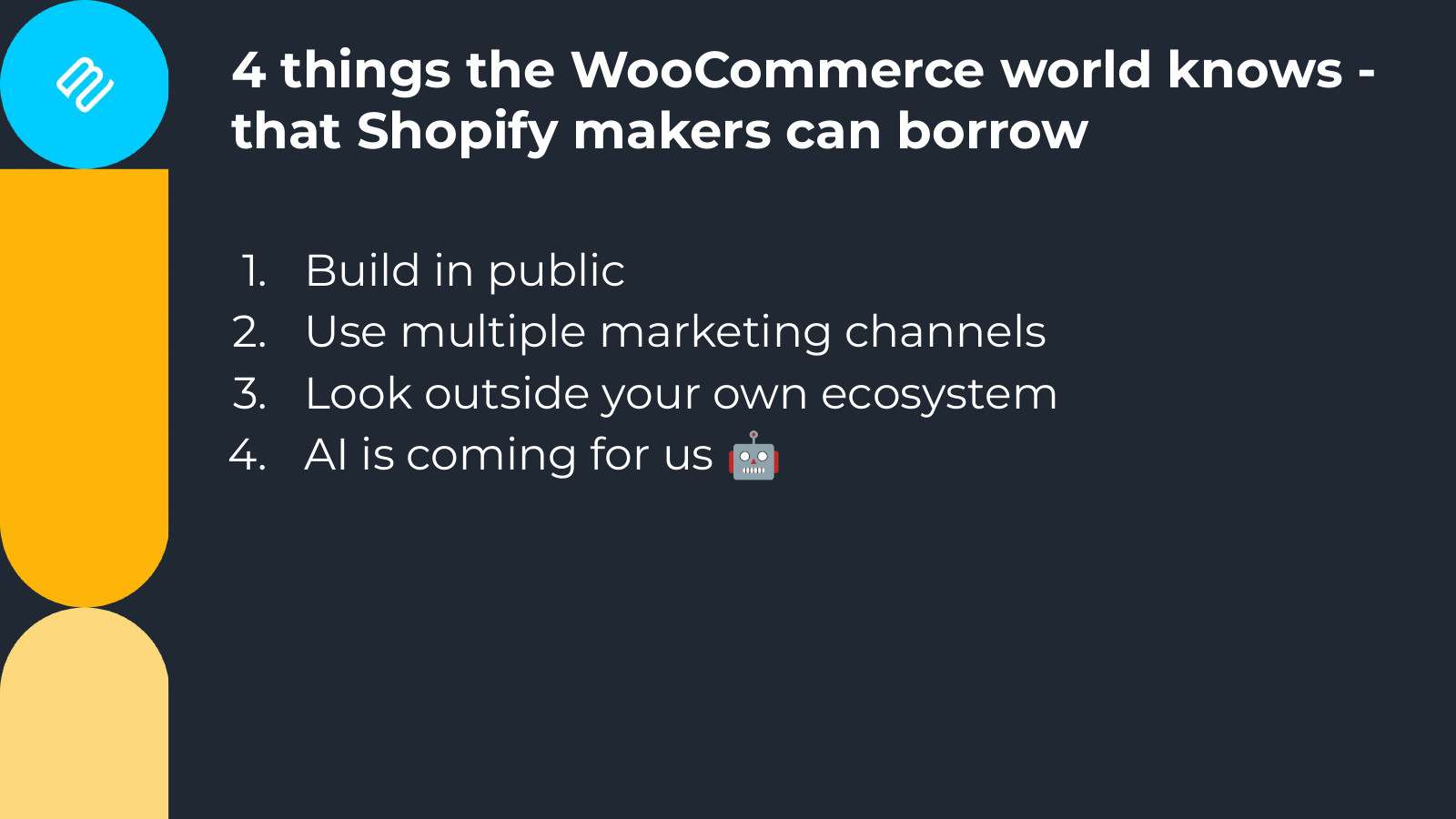
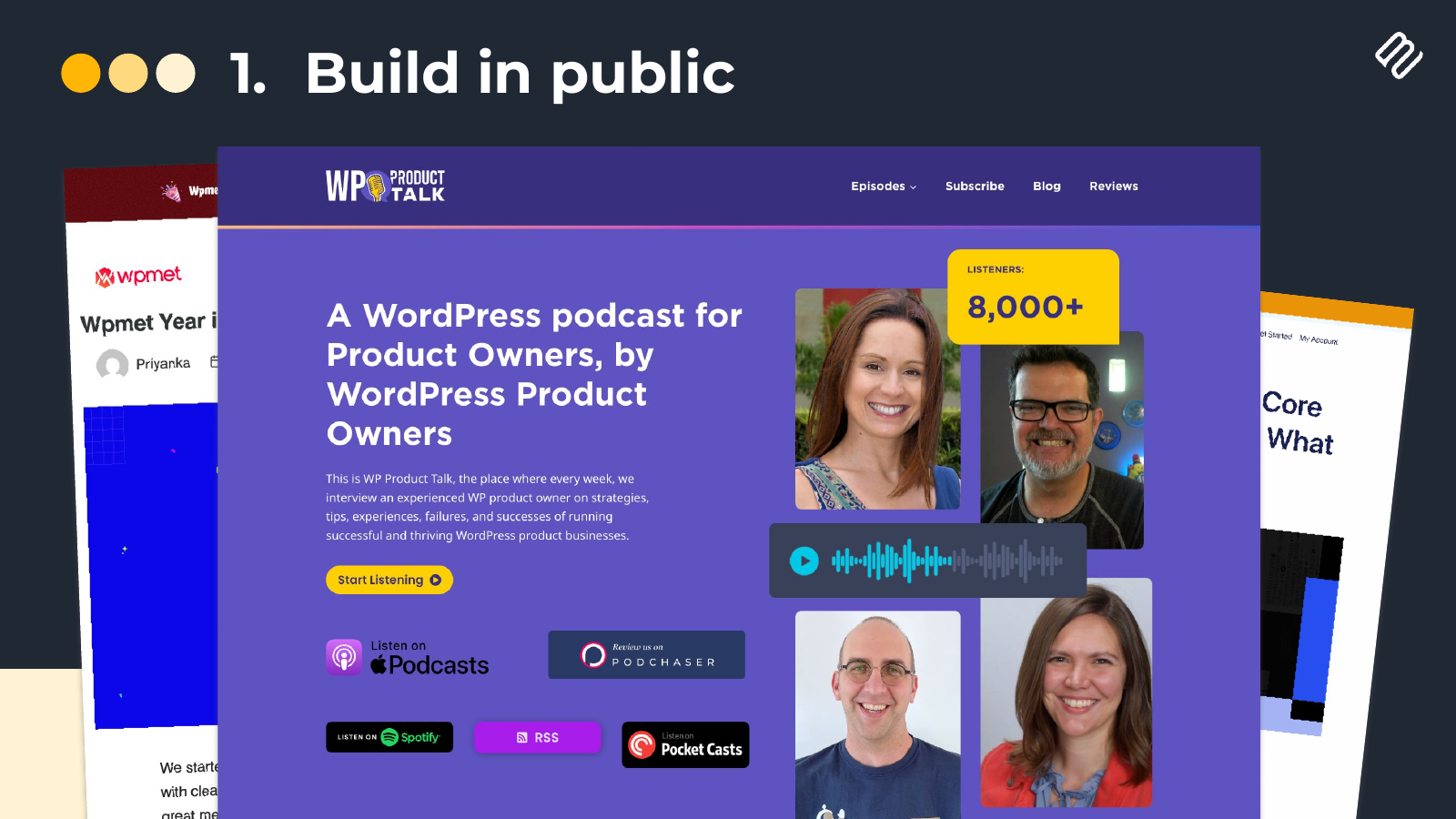
And since then, I've thrown myself into the Shopify world and learned a huge amount, and we've launched our first three apps with a fourth on the way. And I think that being the new person from another ecosystem has allowed me to see things that those of you who are just in Shopify maybe don't see, and that's what I'm going to share with you today. We're going to talk about the importance of building in public, the importance of using marketing channels to promote your products. The importance of using research beyond just your immediate ecosystem when you're learning and getting ideas and finally some risks that I think that AI is bringing our way which Shopify has been a bit protected from so far but that that may not last forever. So let's start with building in public. I know that some people in Shopify are good at this. Matt DeSousa is obviously the king in this area and does an amazing job. But overall WordPress people tend to be more open about how they run their businesses. This happens all year round but it's particularly obvious at the time of year when we have new year and every not everybody but a big proportion of WordPress companies publish a year in review and a transparency report, us included as you can see and everybody likes that. And I will tell you that since I started sharing, people have trusted me, respected my business, and it's actually given me a lot of credibility. Even when I talk about things that aren't working or challenges or something, people just trust you and respect you more because of it. It also brings opportunities your way. I remember the first time I ever mentioned revenue publicly. It was years ago. I think we were doing 28,000 a month and I mentioned that in an interview on quite a high profile website. Well, suddenly everybody wanted to partner with me. They could see that I had a decent audience and that maybe that would benefit them. Whereas if they didn't know that we were actually doing quite well, they didn't know how to prioritise that. And another thing that I do in WordPress is that I co-host a podcast called WP Product Talk, where we talk openly about various elements and angles to growing a successful software product company.
I think this is a bit of a gap in Shopify that I'd like to see filled. The Shopify app show is already taking good steps in that direction, but if you actually check it out, WordPress product talk has a lot of things that are relevant to app companies. We've even had Prakash as a guest.
So actually you could learn something. But I'd also like to see more Shopify podcasts in that direction, having those really open conversations so that we can all grow together. Now another thing that I've really brought to my Shopify work is that in WordPress there isn't one magical marketplace like you have for the Shopify app store.
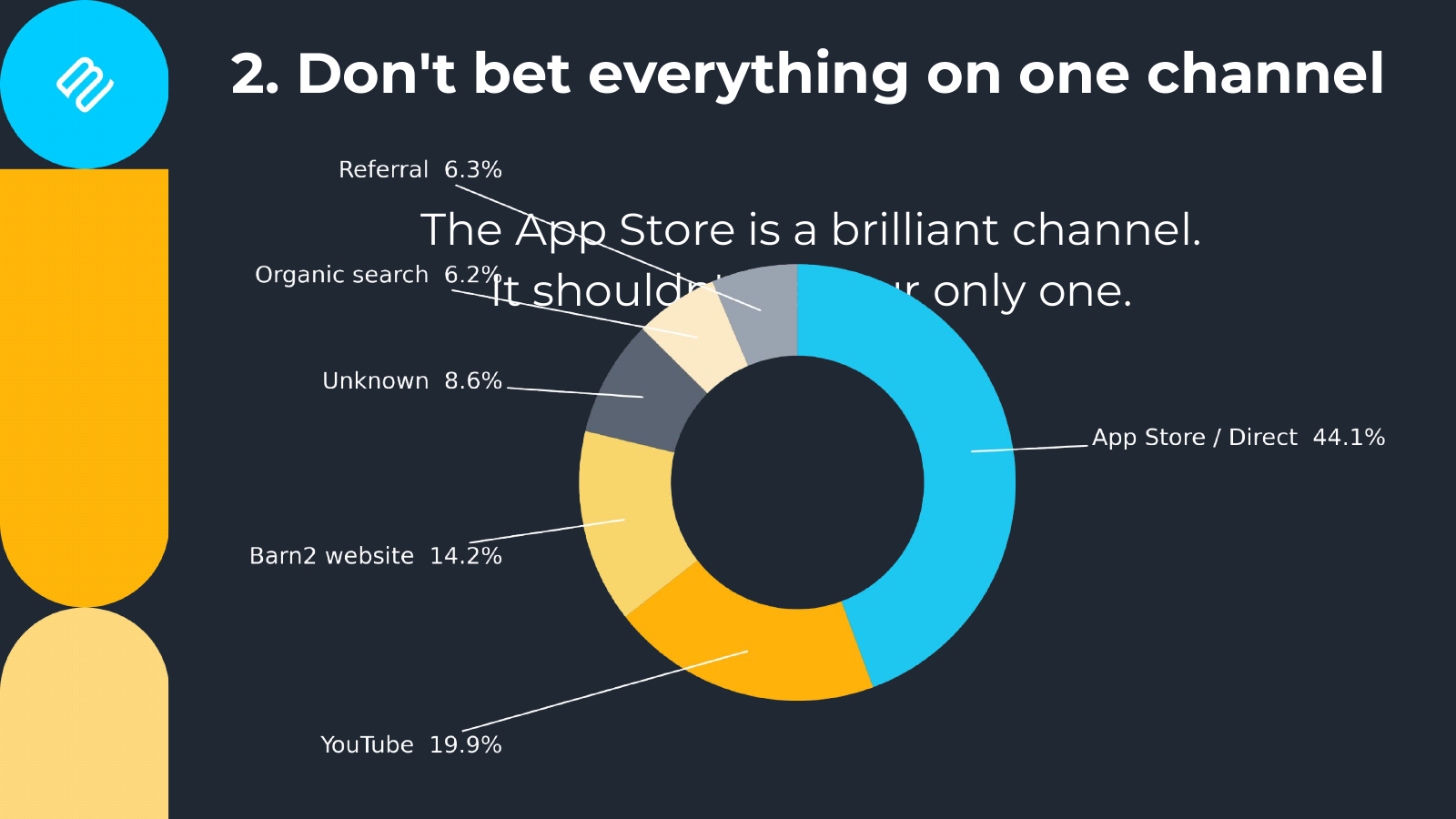
We don't even sell our plugins on any marketplaces. we sell on our own website. So as a result, we've got very good at things like Google Organic and YouTube and owning our own marketing channels, email, all of that kind of thing.
And in Shopify, I think a lot of app sellers that I've made are a bit complacent because the app store is so good. And if you can rank on it, it's a fabulous source of installs. But I think you might be leaving money on the table if you're just relying on the app store for your installs.
So here's a chart of our Vantu bundles and bulk discount apps installs. Admittedly, we are not yet ranking on the app store, and I chose a first app that was in way too competitive an area which I am now regretting. But nonetheless, you can see that we are getting significant installs from other sources, such as our blog and our YouTube channel in particular.
So I think that you can get more installs by expanding into other channels as well. Now, another area is research. I've noticed that most app people tend to research on the app store.
So you're looking at other apps to get ideas, do competitive research, think about new features, think about how to approach what you're building. And this has created, what I see as a really weird insular circle within Shopify where everyone's copying each other. But coming from outside, it's really weird because sometimes, actually very often, the same feature or the same app is completely different from how other ecosystems have solved the same problem.
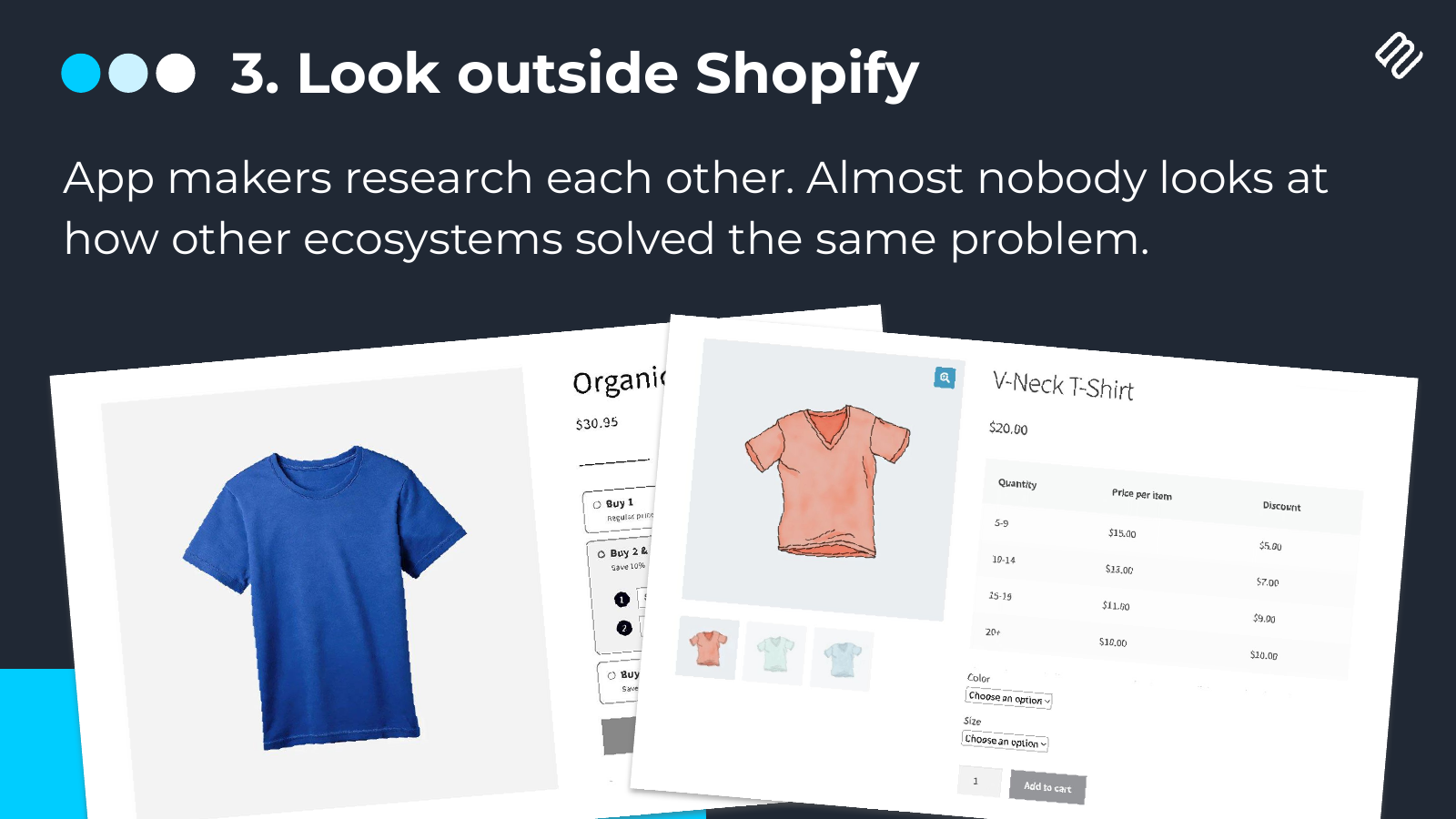
Now, I'll give you some examples. Now, I'm sure you all know what this is. Everybody in Shopify has seen volume bundles.
Well, when I started researching quantity discounts in Shopify to get app ideas, I kept seeing these volume bundles. Well, I had literally never seen that in any WooCommerce plugin. It's just weird 'cause it's huge in Shopify.
So naturally, I immediately added that feature to my WooCommerce discount manager plugin. But on the other side, this is how WooCommerce plugins tend to approach volume pricing. They have a more tiered pricing structure where you enter the tiers that they automatically get discounts.
It's not displayed as a bundle. So obviously I added that to our Shopify quantity pricing app. And there's loads of examples like that.
Things are just done differently. But if you think about it, surely the merchants needs are the same. These are all e-commerce merchants.
So why would they need different sorts of volume discounts based on the platform? Because of that, my advice is to research how other platforms solve your problem, and you might find some features for your apps that your competitors in shop if I haven't thought to do yet. Now the final one is about AI.
Well, firstly, I love AI. It's totally transformed how I'm doing my business. I'm achieving things every day that I would have thought impossible six months ago.
AI is also killing my business, which is not good. First of all, AI search has just slaughtered our traffic. As I said, well, most of our WooCommerce product sales come from Google Organic, and that has been massively hit by AI.
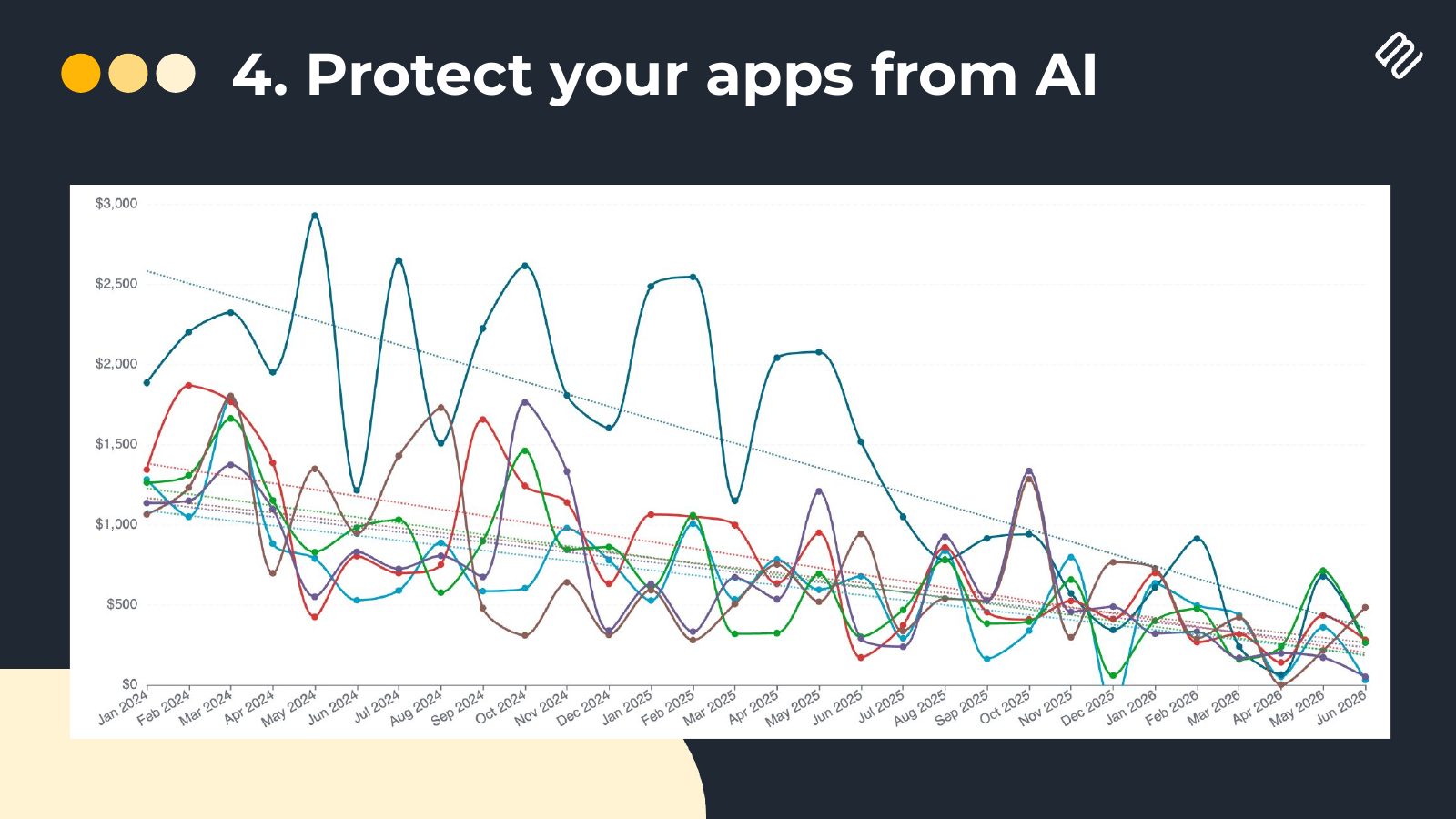
And another category, which I think is more relevant to Shopify, is the type of app that you sell. So we sell lots of different WooCommerce plugins and a lot of them are quite small utility plugins that add one particular feature to WooCommerce. And this is the sales of those smaller plugins.
Disaster, as you can see, over the past two years. And I'm not gonna blame Matt Mullenweg and his word pressure drama for that. I think it's about changes in search and also the fact that it's so easy to vibe code a small utility plugin.
Now, so how does this affect Shopify? Well, I think that you're a bit shielded at the moment, but that might be sensing a, creating a false sense of security. Platform, as a platform, Shopify is growing.
And so you are probably hopefully seeing growth still. So therefore you don't know how much additional growth you might have lost because of AI. The App Store also is doing a fantastic job at shielding you that's nothing to do with the fact that people are now finding apps.
So my plugins are affected because we relied on Google, but the app store not so much. And obviously you can get found inside kick and things like that. But nonetheless, this is still there in the background.
And I would say that if you have small feature specific apps, then you might be at risk of people using AI to replace them. So my advice is to build a very clear moat around your app, whatever it is. Your moat can be the depth of integration with the merchant store.
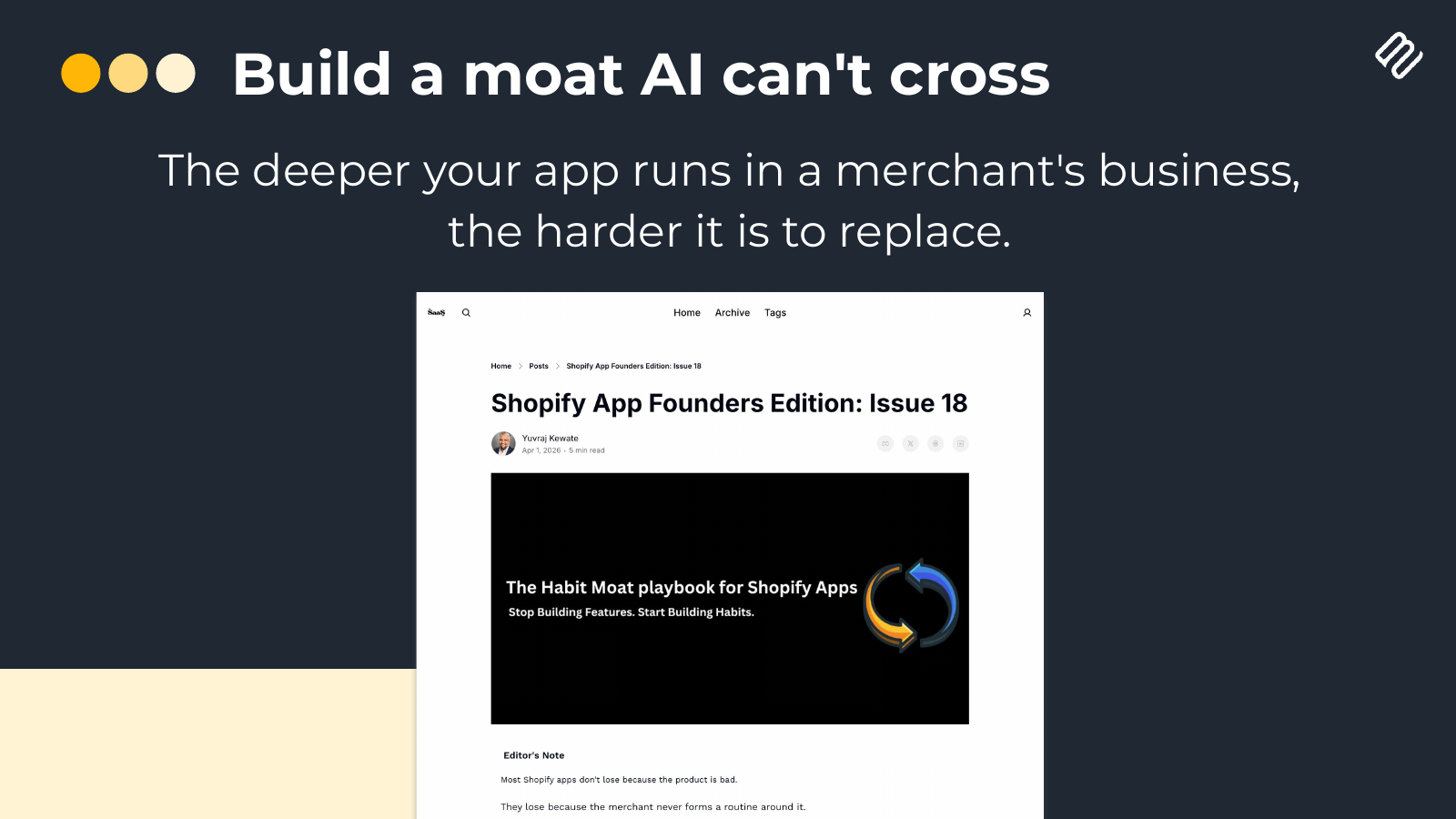
It needs to be really deeply interwoven into their workflow, their data, their tools, how they run their business. You need to be part of their infrastructure, not just a feature that they've bolted on. And to help you with that, I'm going to recommend that if you're not already signed up to this, The Shopify app founders edition newsletter is excellent.
And a few months ago, they published a HabitMote playbook, which I've actually used Claude Code to build an internal tool to perform mote analysis of each of my products directly using this playbook. So if you haven't signed up already, do so, and then you can access the mote playbook in their back catalog. And that's it.
As AI reshapes our world, I think that a cross ecosystem view can be very valuable. I recommend that you look beyond the Shopify bubble at the bigger picture and you can learn a lot that will make your business even stronger. Thank you.
MC: Great, thank you. Okay, we've got a couple of minutes for questions. If anybody has some questions that they wanna get in really quick.
Audience: Hi, I have a question for you. What is the biggest surprise coming to the shop of our ecosystem from the WordPress one?
Katie: The biggest surprise is how a slave you are to the app store and how it works, particularly the review system. I don't like the loss of independence that I feel that has given me because it's like, in 10 years of selling WordPress plugins, I've never felt blackmailed by a merchant to add a feature and I have felt that in Shopify for fear of a bad review.
MC: That really resounded, so more questions.
(laughs) Any other questions?
Audience: Hi, working with WordPress companies, using WordPress and Shopify both, do you feel like there's a trend, people moving from one to the other, or have you seen people moving from Shopify back to WordPress? How do you see your business going? Do you see a future where you might just do Shopify the trend is going there or not? What is your experience there? Because we see both ecosystems.
Katie: How open to be? I think the data says that yes, some people move from Shopify to WooCommerce, but the tide is going towards Shopify. Much more people are leaving WooCommerce to go to Shopify and in particular more new stores are choosing Shopify. As a WooCommerce person, I think 99.7% of my revenue is still coming from WordPress. That terrifies me because I can, and like coming to events like this, there's so much credibility and direction and vision from Shopify that I feel much more confident in its future and need to keep working at this Shopify app thing.
MC: That's great.
Audience: Thanks very much. Great talk. Thank you. I was curious, have you looked at other e-commerce platforms as well or are you just taking with e-commerce and Shopify?
Katie: Shopify was very obvious because it is probably the market leader now depending on what data you look at but it's rising so rapidly. It feels like the way to go. I did submit my first Wix app last week, but that's just a bridging app for a SaaS that I've built rather than specific to Wix. I'm going to add this to multiple platforms and to Shopify versions already live. Shopify was the obvious one to me.
MC: Do you have time for one more? One more. Okay.
Audience: In the previous answer, you said that we are slaves to the app store. your personal approach to solving that for you? I know you're doing more block stuff, you're trying to curate more channels, but in the end the app store is still pretty important. How do you approach that? I think most of people in
Katie: the room know the answer to this better than me, but I think you have to play the game. The app store is immensely valuable to any Shopify business and it would be ridiculous to not play that game, so I just need to suck it up and and continue doing it.
MC: Awesome, thank you.
Katie: Thank you so much.